LoRA: Fine-Tuning Without Retraining the Whole Model
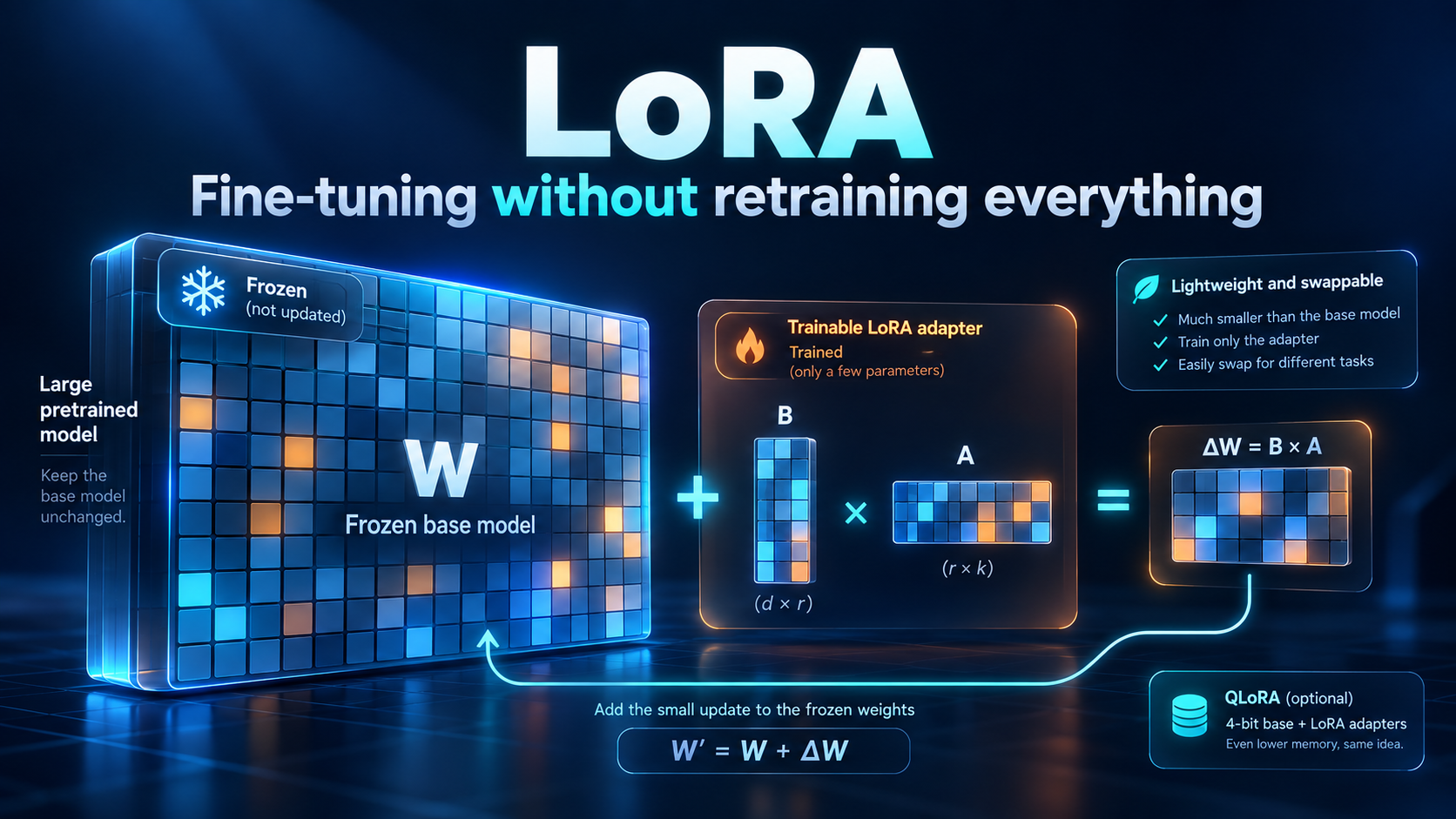
When prompting hits a ceiling, teams often assume fine-tuning means retraining billions of parameters on a GPU cluster. LoRA (Low-Rank Adaptation) is why that's no longer true.
The idea
Instead of updating a layer's full weight matrix W, LoRA freezes W and learns a small update expressed as the product of two skinny matrices, B × A, where the shared inner dimension is the rank (r). With r = 8 on a 4096×4096 layer, you train roughly 65K values instead of 16.7M. The adapter is a small file you can swap in and out on top of the same base model. The original paper reports cutting trainable parameters by about 10,000× versus full fine-tuning of GPT-3 175B (Hu et al., 2021).
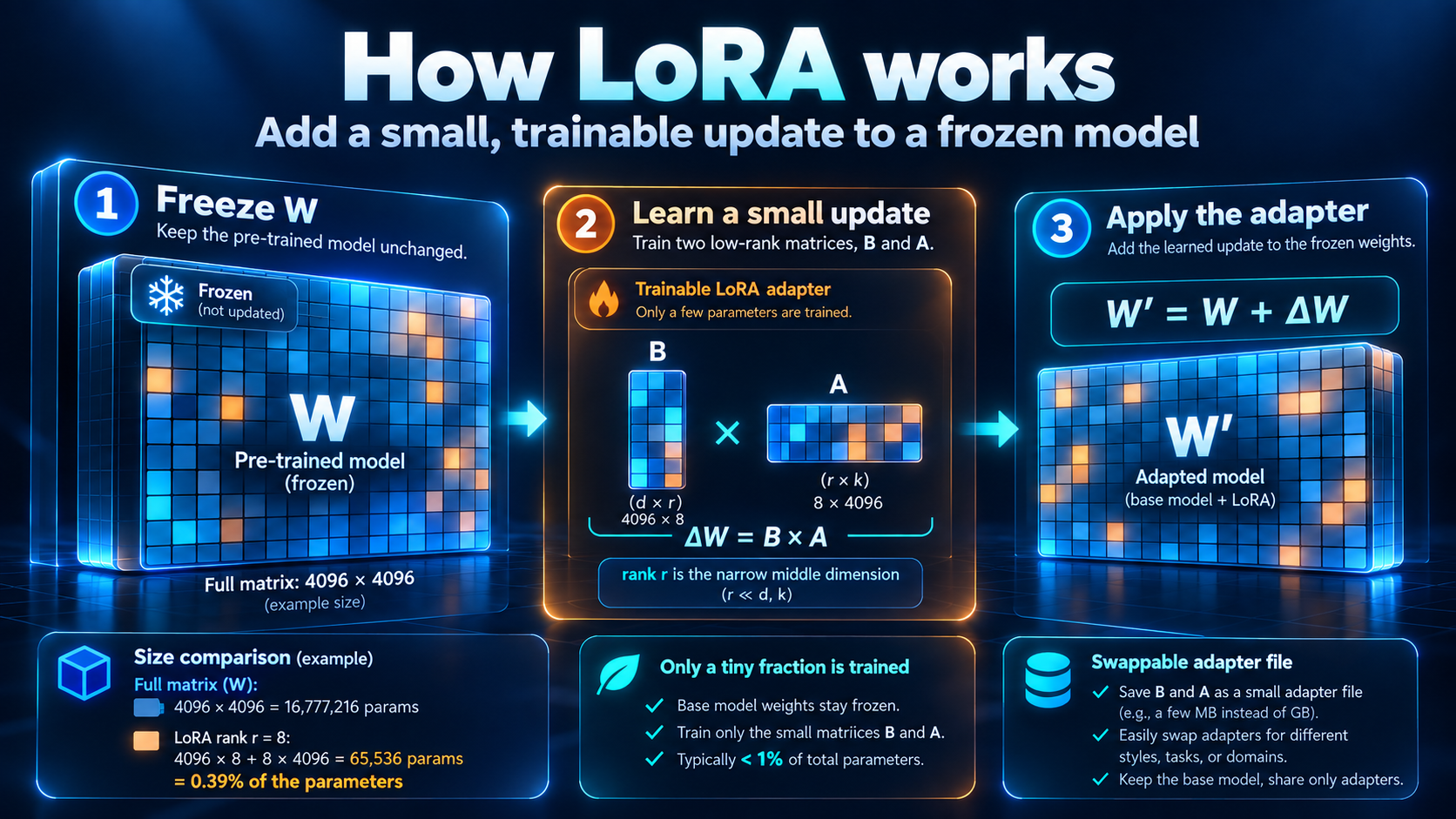
QLoRA goes further: it keeps the frozen base model in 4-bit precision while training LoRA adapters in higher precision, which let researchers fine-tune a 65B-parameter model on a single 48GB GPU (Dettmers et al., 2023).
A minimal config (Hugging Face PEFT)
python
from peft import LoraConfig
config = LoraConfig(r=8, lora_alpha=16, target_modules=["q_proj", "v_proj"], lora_dropout=0.05)
Common practice is to set alpha to about 2× the rank, then tune from there (Raschka, n.d.).
When to reach for it.
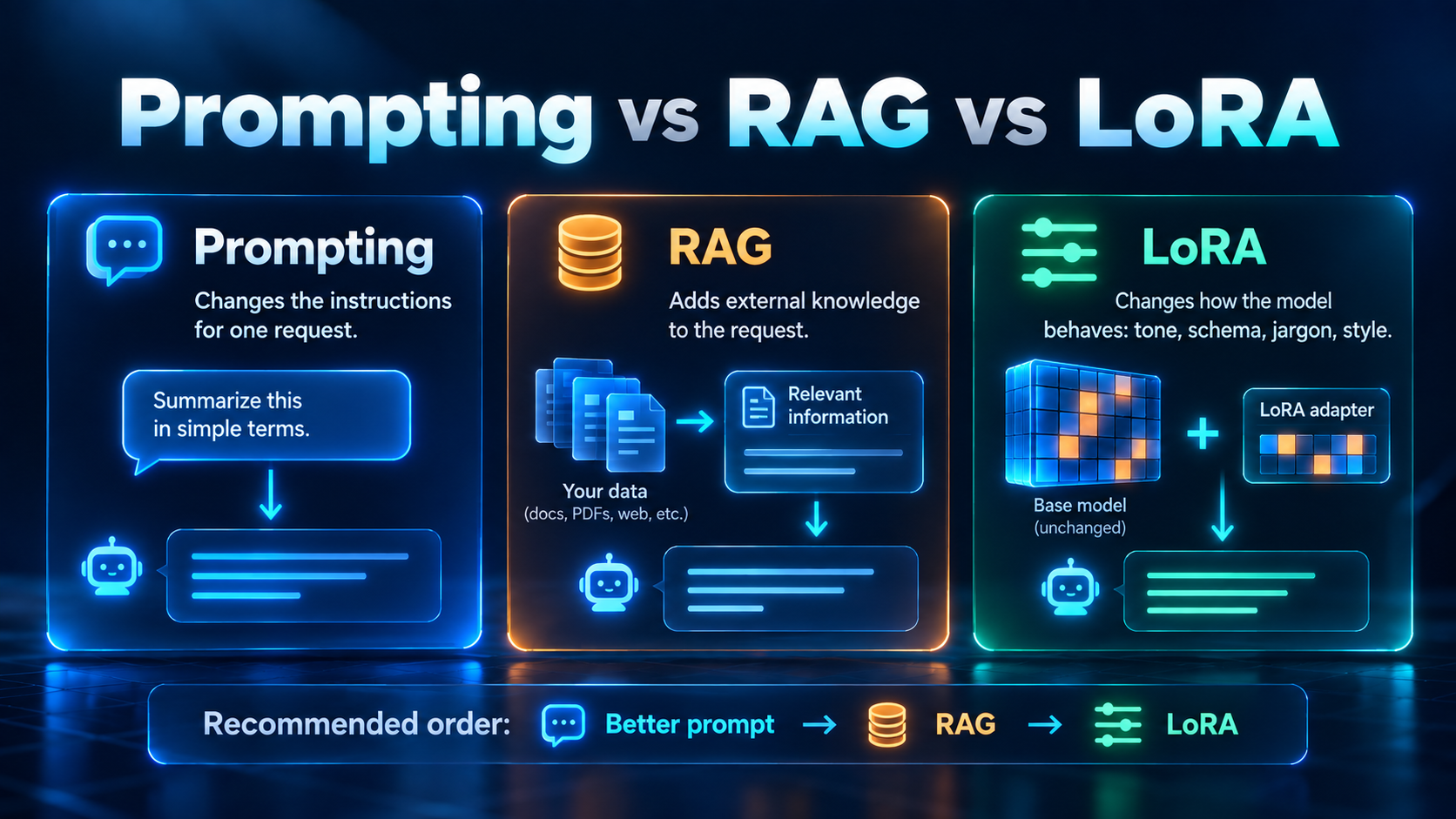
Prompting and RAG change what the model knows in a given request. Fine-tuning changes how it behaves: a consistent tone, a strict output schema, domain jargon, or a small model that must match a bigger one on a narrow task. My order of operations: better prompt, then RAG, then LoRA.
Why it matters
You get most of the benefit of fine-tuning at a fraction of the compute, with adapters you can version and swap like config files.
References
Dettmers, T., Pagnoni, A., Holtzman, A., & Zettlemoyer, L. (2023). QLoRA: Efficient finetuning of quantized LLMs. arXiv. https://arxiv.org/abs/2305.14314
Hu, E. J., Shen, Y., Wallis, P., Allen-Zhu, Z., Li, Y., Wang, S., Wang, L., & Chen, W. (2021). LoRA: Low-rank adaptation of large language models. arXiv. https://arxiv.org/abs/2106.09685
Raschka, S. (n.d.). LoRA rank and alpha. Sebastian Raschka's FAQ. https://sebastianraschka.com/faq/docs/lora-rank-alpha.html