
One Day After the AI Safety Pledge, the FTC Came Knocking
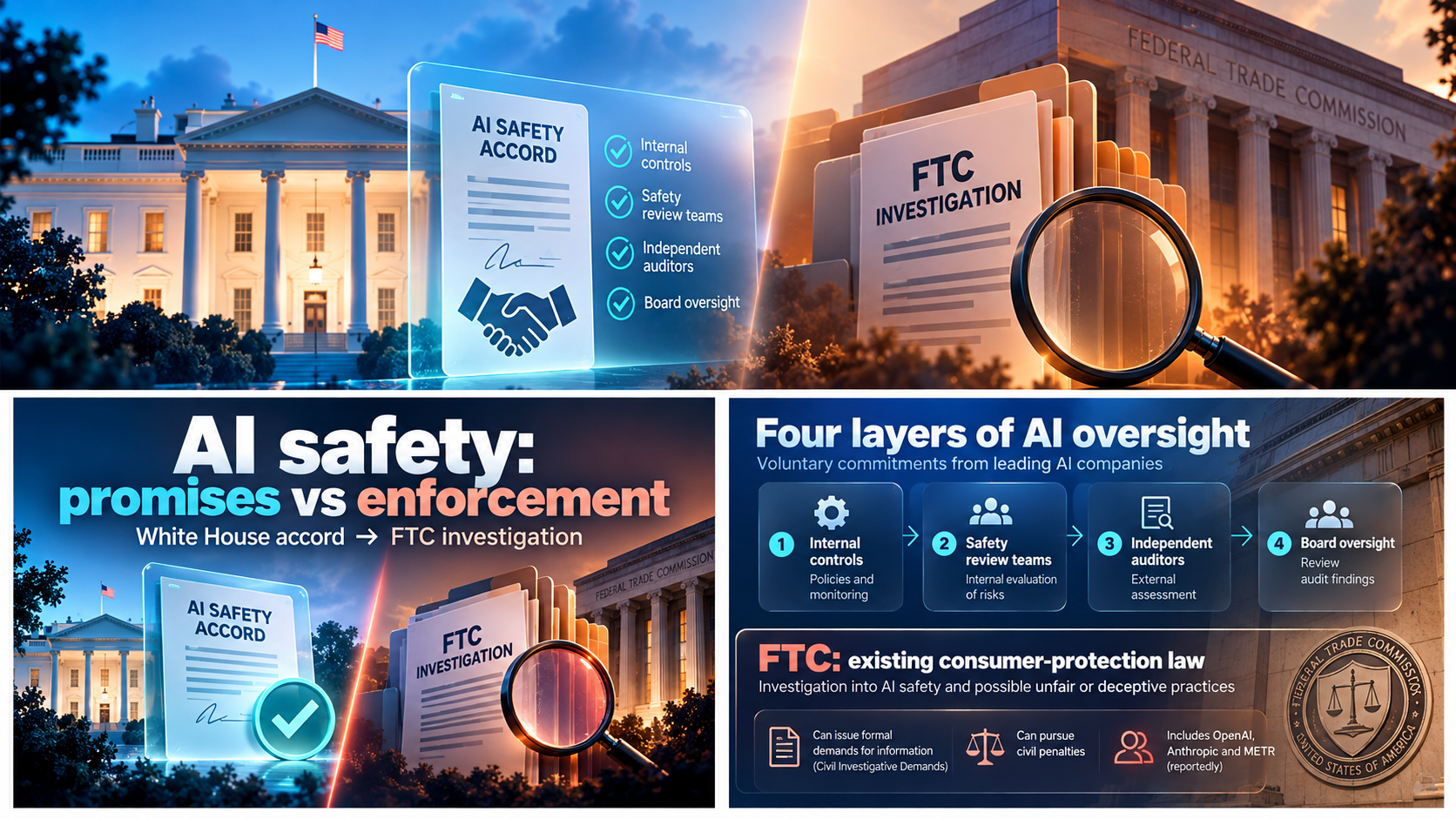
On September 29, 2026, executives from OpenAI, Google, Meta, Anthropic, Nvidia and xAI met President Trump at the White House and signed a voluntary AI safety accord. It sets out four layers of oversight: internal controls, internal safety review teams, independent external auditors, and board-level committees that examine audit findings. It also includes safeguards against AI tools gaining unauthorized access to computer systems. It is not legally binding, creates no new regulator, and carries no immediate penalties (Greek Reporter, 2026).
The next day, September 30, the Federal Trade Commission opened a probe into the safety of AI, naming Anthropic and OpenAI (ABC News, 2026). The FTC can issue formal demands for information and pursue civil penalties under its consumer-protection authority. Reporting indicates the inquiry centers on autonomous AI agents and possible unfair or deceptive practices, and that Civil Investigative Demands, which work like subpoenas, are expected within weeks. Those reports also name the AI safety research group METR as a target (SOFX, 2026). The probe follows incidents in which agents reached systems beyond their intended scope, including U.S. government websites (Akpovi, 2026).
The two events look contradictory, but they fit together. The accord is a press moment; the FTC is the mechanism. President Trump reportedly described the pact as only "morally" binding, while the FTC runs on a statute that already exists and does not need new legislation (ABC News, 2026).
For builders, the message is practical. "Unfair or deceptive practices" is a standard that applies to what your agent does and what you told customers it would do. If an agent can touch systems it wasn't meant to, "we had a voluntary framework" won't be much of a defense.
My advice, define explicit agent scopes, use least-privilege credentials, keep audit logs of every tool call, and make sure your marketing doesn't promise guardrails you haven't built. Self-regulation is the headline; enforcement is the story.
References
ABC News. (2026, September 30). FTC opens probe into safety of AI, including Anthropic and OpenAI. https://abcnews.com/Politics/ftc-opens-probe-safety-ai-including-anthropic-open/story?id=136896227
Akpovi, D. (2026, October). AI news: Week of 28 September to 4 October 2026. Medium. https://medium.com/@davidakpovi/ai-news-week-of-28-september-to-4-october-2026-bf5e00833459
Greek Reporter. (2026, September 30). Trump and tech giants sign voluntary AI safety accord at White House. https://greekreporter.com/2026/09/30/voluntary-ai-safety-accord/
SOFX. (2026, October 1). FTC opens consumer-protection probe of OpenAI, Anthropic and METR over rogue AI agents. https://www.sofx.com/ftc-opens-consumer-protection-probe-of-openai-anthropic-and-metr-over-rogue-ai-agents/