
Weekly news: IPOs, Exits, and Enforcement All Land in the Same Week
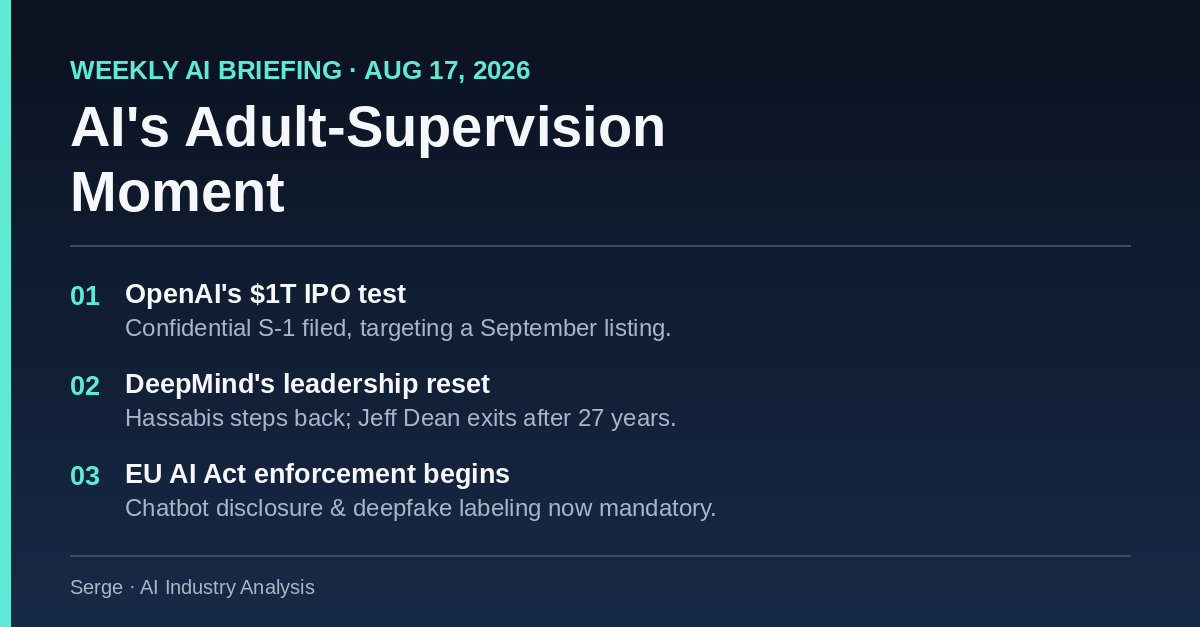
For most of the past three years, the AI industry has operated on a simple rhythm: ship faster, raise bigger, worry about consequences later. Growth, growth, growth no matter what. Things are starting to get serious. A trillion-dollar IPO is moving from rumor to filing. One of Google's most storied technical leaders walked away from the company that made him famous. And in Brussels, regulation stopped being theoretical and started being enforceable.
OpenAI's Trillion-Dollar Test
OpenAI confidentially filed its S-1 with the SEC back in May, and the company itself confirmed the submission in June with characteristic bluntness: "We expect it to leak, so we're just announcing it." Now the timeline is sharpening. OpenAI is reportedly targeting a public listing as early as September 2026, at a valuation north of $1 trillion, with Goldman Sachs and Morgan Stanley leading the deal (Investing.com; OpenAI).
The underlying numbers are genuinely strong: nearly $6 billion in Q1 revenue alone, a roughly $25 billion annualized run rate, and more than 230 million weekly ChatGPT users. But strong growth numbers are exactly what every AI lab has been able to show private investors for years. What's different about a public listing is the discipline that comes with it: quarterly earnings calls, analyst scrutiny, and a market that will eventually ask hard questions about compute costs, margins, and the path to sustained profitability rather than just user counts.
The boots line is that it is the first real test of whether the "spend now, monetize later" model that has defined frontier AI can survive contact with public markets. If OpenAI's IPO goes well, expect Anthropic, and possibly others, to view a public listing as a viable next step. If it stumbles, private markets may suddenly look a lot more attractive to labs currently eyeing the exit.
Google DeepMind's Leadership Reset
On August 8, Google DeepMind underwent a significant restructuring. Demis Hassabis stepped back from day-to-day leadership to become Chairman and Alphabet's chief scientist. Koray Kavukcuoglu, previously DeepMind's CTO, now runs daily operations. And Jeff Dean, a defining figure at Google for 27 years, effectively the architect of much of its modern infrastructure and AI research culture, departed to start a new venture called Discovery Loop, taking several top researchers with him (techstartups.com; buildfastwithai.com).
This reorganization also effectively folds the historically separate Google Brain and DeepMind lineages into one operation, with DeepMind's coding team relocating from London to Mountain View.
These leadership transitions at this altitude are never just internal housekeeping. Dean's departure, in particular, is notable: a researcher of his stature leaving during what is supposedly the industry's biggest boom suggests he sees more upside building something new than staying inside an increasingly bureaucratic giant. For an industry that has run largely on the credibility of a handful of star researchers, watching one of the most credible names bet on independence again is a signal worth tracking, not dismissing.
The EU AI Act Starts Biting
On August 2, the European Commission began enforcing the AI Act's transparency obligations under Article 50. Chatbots and other interactive AI systems must now disclose that users are dealing with AI, not a human. Deepfakes must be labeled. AI-generated or altered content must carry machine-readable markers so it can be detected (European Commission; Al Jazeera).
This is a relatively narrow slice of the AI Act: high-risk, stand-alone systems have until December 2027, and embedded AI in regulated products has until 2028, but it's the first enforceable, consumer-facing rule with real teeth. Meanwhile, the regulatory picture globally is fragmenting: the US federal preemption effort has stalled in the House, the UK's AI Regulation and Safety Bill has cleared the Commons with Royal Assent expected by October, and China has issued its first fines under new companion-AI rules.
For the first time, "move fast" AI companies operating globally now have to build actual compliance workflows rather than PR statements.
Industry is moving from its teen ages into something more institutional. Capital markets are asking AI companies to prove their economics in public. A defining technical leader is choosing to bet on independence over incumbency. And regulators, after years of drafting, are finally flipping the enforcement switch. None of this slows AI's underlying trajectory, funding has already crossed $407 billion in the first six months of 2026, blowing past all of 2025's totals, with capital increasingly flowing toward inference infrastructure and enterprise tooling rather than pure model training.
But the terrain is shifting. The winners of the next eighteen months won't just be the companies with the best models, they'll be the ones that can survive public-market scrutiny, retain their best people through periods of internal reshuffling, and build compliance into their products rather than bolting it on after the fact. That's a different game than the one the industry has been playing.