When AI Disruption Never Stops, Stop Managing It Like It Will
A product leader spends six weeks building a customer workflow around a specific AI model. The day the team finally ships it, a cheaper, faster competitor model lands, and the investment is obsolete before it has fully proven itself. That's the opening scene of a recent MIT Sloan Management Review piece, "When AI Disruption Never Ends", and if you lead a technology team right now, you have almost certainly lived a version of it.
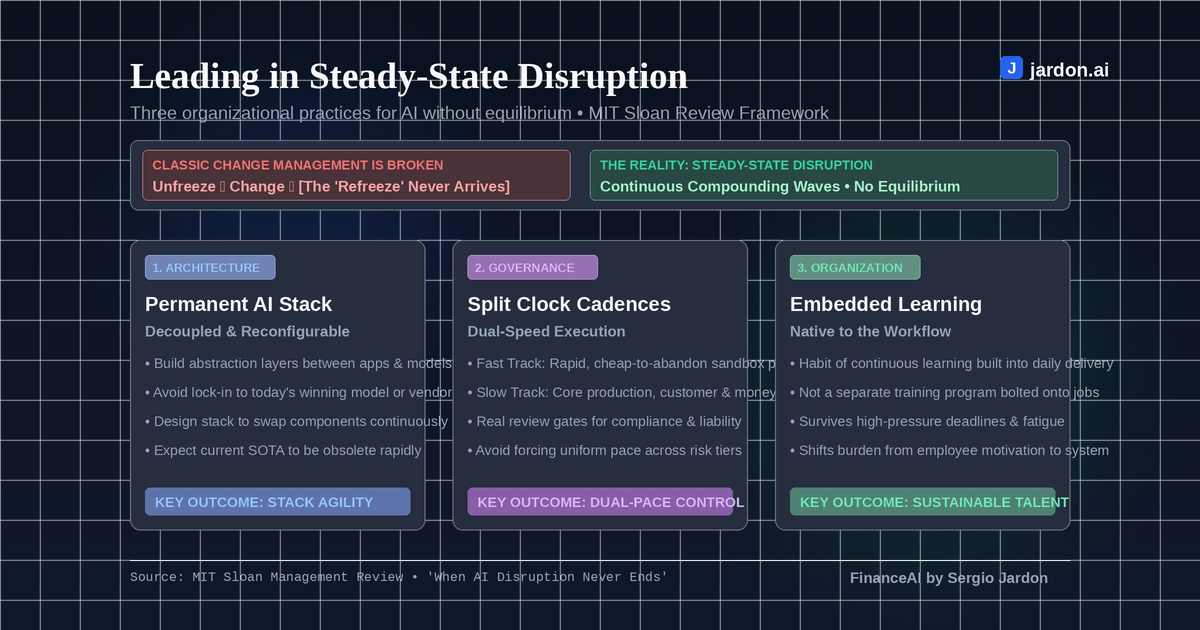
MIT Sloan's core argument is that AI has quietly changed the nature of disruption itself. Instead of arriving as a discrete event with a before and after, it has become what the article calls "steady-state disruption": a condition in which capability shifts land continuously and compound on one another, with no equilibrium ever coming into view. Each new generation of AI helps build and train the next, so the interval between waves keeps compressing rather than settling into a predictable rhythm. There is no finish line to sprint toward and organizations that keep looking for one are setting themselves up to burn their people.
That last point is worth sitting with. Most change management doctrine, the kind every MBA program still teaches, assumes disruption has a shape: unfreeze, change, refreeze. You absorb the shock, stabilize, and move on. MIT Sloan's argument is that this model quietly breaks under AI, because the "refreeze" step never arrives. The fatigue that follows isn't a motivation problem. It's a structural one.
Three practices for a world without equilibrium
The article's more useful contribution is what it proposes instead: three organizational practices that shift the burden of constant change away from individual employees and onto the organization's design.
The first is permanent AI infrastructure: treating your technology stack as something built for continuous reconfiguration rather than optimized around whichever model happens to be winning today. That means abstraction layers between your applications and any single model or vendor, and procurement and architecture decisions that assume today's best-in-class tool will not hold that position for long.
The second is split cadences: deliberately running different parts of the organization at different clock speeds. Experimentation and evaluation move fast and stay cheap to abandon; the systems that touch customers, money, or regulatory obligations move on a slower, more deliberate cycle with real review gates. The mistake most organizations make is applying one uniform pace to everything, which either strangles experimentation with governance or lets governance-worthy decisions move at experimentation speed.
The third is embedded learning: building the habit of learning into the work itself rather than treating it as a separate training initiative that competes with delivery deadlines. When upskilling is a parallel program bolted onto people's real jobs, it's the first thing that gets dropped under pressure. When it's structured into how the work actually gets done, it survives the pressure.
The takeaway
None of this is really about AI models. It's about accepting that "temporary" was never going to be true, and designing your organization accordingly. If you lead a team right now, the practical test is simple: audit your stack for single-model dependencies, check whether your governance process runs at more than one speed, and ask whether learning happens inside people's actual jobs or in a separate track competing for their time.
Source: "When AI Disruption Never Ends," MIT Sloan Management Review.