
ReAct: The Loop Behind Most AI Agents
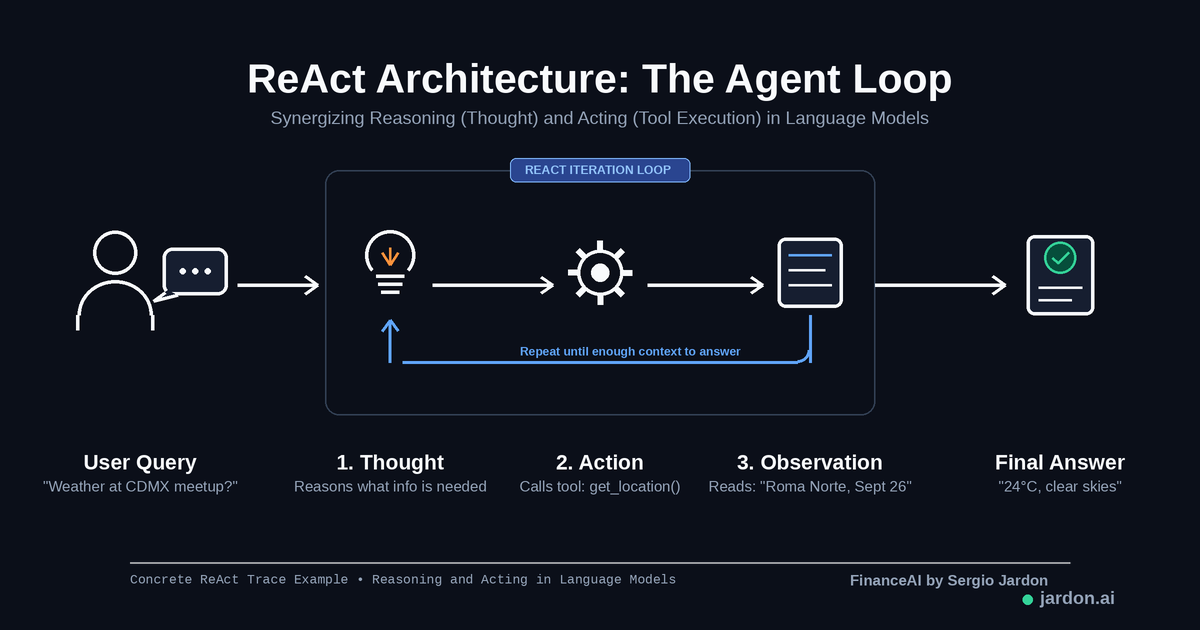
When people say they've "built an AI agent," they usually mean the model can call tools and decide when to call them. Most of those systems are quietly running on a pattern called ReAct, short for Reason + Act. It's worth knowing on purpose, because it's the base that more advanced architectures (ReAct + RAG, multi-agent orchestration, reflection loops) build on top of.
How It Works
ReAct loops instead of running a single pass: Thought (the model reasons about what it needs next), Action (it calls a tool, search, database, API), Observation (it reads the result and decides whether to act again or answer). This repeats until it has enough to respond.
A concrete trace: asked "what's the weather at our next Mexico City meetup?", a ReAct agent reasons
I need the event's location → calls get_next_event() → observes "Roma Norte, Sept 26" → reasons now I need the forecast → calls get_weather("Roma Norte", "Sept 26") → observes "24°C, clear" → answers.
Each step is grounded in a real tool result, not a guess.
Use Cases
- Multi-step lookups with no fixed sequence, like diagnosing a support ticket across several systems
- Tasks needing mid-task re-planning based on what a tool returns, research or debugging agents
- Workflows where you must audit why the agent acted, since the reasoning is written out at each step
- Any task where grounding in a live tool meaningfully cuts hallucination versus pure chain-of-thought
Weaknesses
- Token/cost overhead: a "Thought" at every step costs more than one structured function call, overkill for simple, fixed-sequence tasks
- Compounding errors: misreading one observation early drags every later step off course with it
- Runaway loops: without a hard iteration cap, the agent can get stuck repeating the same thought-action cycle
- Tool hallucination: the model can "call" a tool or parameter that doesn't exist when tool descriptions are vague
If you're building your first agent, ReAct is the place to start, everything more advanced in this series builds on this loop.
References
MetaDesign Solutions. (2026). Using the ReAct pattern in AI agents: Best practices, pitfalls & implementation tips. https://metadesignsolutions.com/blog/using-the-react-pattern-in-ai-agents-best-practices-pitfalls-implementation-tips
Yao, S., Zhao, J., Yu, D., Du, N., Shafran, I., Narasimhan, K., & Cao, Y. (2022, October 6). ReAct: Synergizing reasoning and acting in language models. arXiv. https://arxiv.org/abs/2210.03629