
AI's Growth Story Met Its Shadow
Three storylines converged this week that say more about where the AI industry stands than any single headline could. Two of the most valuable AI labs on earth inched toward the public markets. Public opinion on AI hit a new low. And OpenAI posted a landmark usage milestone the same week it cut prices again.
The IPO race: Anthropic pulls ahead of OpenAI
Anthropic told investors its annualized revenue run rate hit $65 billion at the end of July, up from $47 billion in May and roughly seven times higher than a year ago, driven largely by enterprise demand for Claude in coding, research, and automation workflows (Bloomberg, CNBC). That figure now puts Anthropic ahead of OpenAI's reported ~$40 billion run rate. The company confidentially filed a draft S-1 with the SEC back in June, and sources now say it could take the next step as soon as the end of August, following its April Series H round that valued the company at $965 billion.
OpenAI is playing a different game. It also confidentially filed an S-1 in June, and had been targeting a September listing at a valuation as high as $1 trillion. But this week, CFO Sarah Friar told employees that OpenAI "will be a public company in 2027 or sooner" (CNBC).
The backlash becomes a disclosed risk
Public sentiment on AI is moving in the opposite direction from the revenue charts. A Pew Research survey conducted in late June found 52% of Americans are now more concerned than excited about AI in daily life, up from 37% in 2021, with 71% saying they believe AI will cost Americans jobs. For the first time, a majority of adults under 30 (55%) say they're more concerned than excited, a group that had previously been more optimistic than older cohorts (Pew Research).
That sentiment is concentrating around data centers specifically. Recent polling found just 27% of voters would support building an AI data center in their community, worse than every other infrastructure project tested, including nuclear power plants, and opposition is now showing up in local elections and campaign ads (Axios, CNBC). TechCrunch summed up the shift bluntly this week: AI was supposed to win people over by now, and it hasn't (TechCrunch).
The clearest signal of how seriously the industry is taking this: sources say Anthropic's upcoming IPO filing will list "AI backlash" as a formal risk factor (CNBC). Public skepticism about AI has quietly graduated from a communications problem to a line item.
A billion users, falling prices
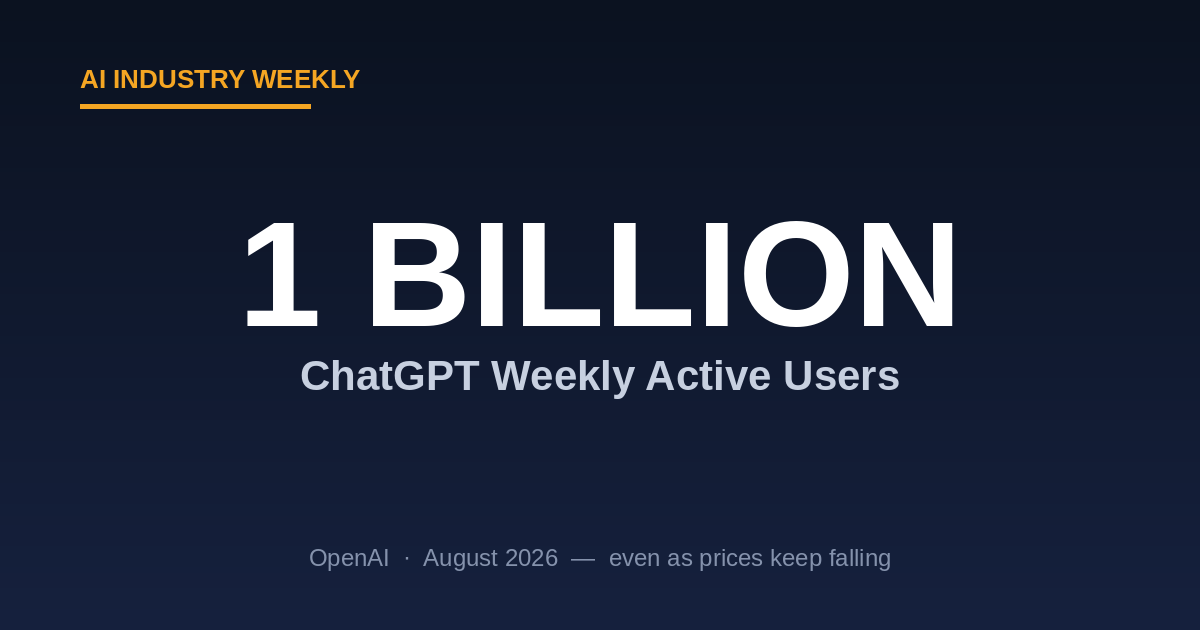
On the other side, OpenAI had genuinely good news: ChatGPT crossed roughly 1 billion weekly active users, according to The Information, arriving alongside the rollout of GPT-5.6 (The Information, Yahoo). It's a genuine milestone, even if it arrives about seven months later than OpenAI had hoped internally.
But the same week, pricing kept falling. OpenAI's budget-tier GPT-5.6 model, Luna, is now priced 80% lower than its predecessor at $0.20 per million input tokens, funded partly by a 20% reduction in inference serving costs. A further round of cuts landed on the flagship Sol model this week too, with input pricing down 20% and output down roughly a third (OpenAI).
Sources: Bloomberg, CNBC, CNBC, CNBC, Pew Research, Axios, CNBC, TechCrunch, The Information, OpenAI